Kitchen Sinks and Faucets
Kitchen Remodeling: A Complete Guide
The sink is the one part of the kitchen you'll touch every single day, and it usually gets picked in an afternoon. Most of what goes wrong here — the sore back, the cabinet surprise, the faucet that spots no matter what — was decided in that afternoon, so it's worth slowing down for one article's worth of time.
Sink materials
Stainless steel is the default for good reasons, and the gauge conversation around it is noisier than it deserves. Lower gauge means thicker steel. Thicker dents less and transmits less noise. What's worth knowing is that Kohler's premium sinks are 18 and 19 gauge, not 16 — the 16-gauge-or-nothing framing is largely a position taken by import brands. Alloy matters as much: type 304 stainless is a chrome-nickel alloy that resists staining and corrosion. And sound deadening matters more than either. Kohler applies rubber pads to every kitchen sink it makes. The premium version also cuts condensation on the underside — a real thing in an air-conditioned Phoenix house.
Enameled cast iron is heavy, quiet, and available in colors nothing else offers. Two things about living with it. Pot marks — the gray streaks aluminum pans leave on the enamel — are not a defect and don't penetrate the surface. They come off with the manufacturer's cleaner and a cork. And abrasive cleaners are out, which matters in hard water, because abrasives are exactly what removes mineral film fastest. One more worth knowing before you buy: Kohler warns that bacteria growing under a rubber dish mat can permanently discolor the enamel, and that damage isn't covered by the warranty.
Fireclay is the classic farmhouse material, and its governing issue is weight — see below.
Composite granite sinks are widely sold here. Pull their specs from the manufacturer rather than a retailer, since the commonly repeated heat and composition figures don't trace cleanly to a source.
An apron sink is a cabinet job
This is the single most underestimated decision on the list. A farmhouse or apron-front sink is not carried by the countertop. It sits on a framed platform built inside the sink base cabinet, and Kohler's installation guide specifies what that takes:
- The false drawer front comes off, and the cabinet's top rail and center support get cut away.
- Horizontal supports run along the interior cabinet walls, with four vertical support pieces carrying down to the cabinet floor.
- The frame has to support a minimum of 300 pounds.
- The cabinet gets notched so the sink rim finishes flush with the cabinet top.
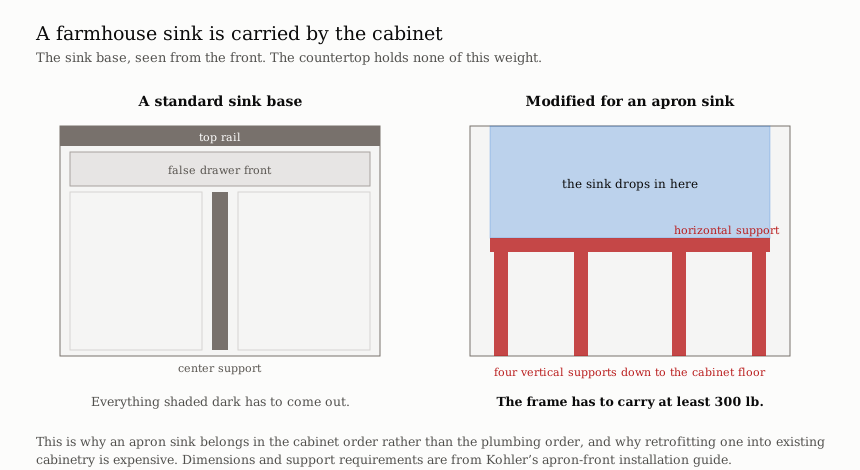
Kohler's own caution is that only trained and experienced installers should be doing undermount work at all. None of this is a reason to avoid an apron sink. It's the reason retrofitting one into existing cabinetry is expensive, and the reason it belongs in the cabinet order rather than the plumbing order.
Depth, and why deeper isn't better
Bowl depth is where good intentions produce sore backs. A 9-inch bowl undermounted below a 36-inch counter puts the working surface roughly 25¾ inches off the floor. One sink fabricator makes the comparison well: that's writing a letter while standing at a desk 25¾ inches high, where the strain shows up within minutes.
The counterintuitive part is that taller people generally want shallower bowls, not deeper ones — a 36-inch counter already sits proportionally low for someone over six feet, and depth compounds it. And drain position does more work than depth: a drain at the rear corner lets a large pan lie flat without blocking it, which is most of what people are actually buying depth for.
That guidance comes from a fabricator who builds shallow rear-drain sinks, so weigh it accordingly. But the arithmetic checks out, and there is no neutral standard for residential sink ergonomics to check it against.
The other cost of depth is invisible until the plumber arrives. Every inch of bowl is an inch taken from the sink base, and a disposal, a P-trap and two shutoffs already fill most of it.
Faucets
The cartridge is the part that fails, and Phoenix water is why. Ceramic disc valves are the modern standard: two polished discs sealing against each other so closely that no rubber washer is needed. A standard cartridge runs somewhere around five to ten years. Faucets get tested in distilled water; tap water full of minerals shortens that considerably. Delta's Diamond Seal design embeds diamond particles that keep polishing the mating disc and grinding off deposits, which in a 16-grain water market is a functional feature rather than a marketing one. A mineral-stiffened cartridge will often free up after a long soak in vinegar, which is worth trying before buying a replacement.
The certification to look for is ASME A112.18.1 / CSA B125.1, the standard covering plumbing supply fittings from the shutoff to the spout. The EPA points builders at it specifically because WaterSense doesn't cover kitchen faucets at all — the WaterSense faucet label applies to bathroom lavatory faucets only.
Flow rates. The federal maximum for a kitchen faucet is 2.2 gallons per minute at 60 psi. The EPA's whole-home program recommends 1.5 to 1.8 as a target rather than a label. California capped kitchen faucets at 1.8 gallons per minute in 2016, with a permitted momentary boost back to 2.2 for filling a pot. Because California drives national manufacturing, most current faucets ship at 1.8 regardless of where they're sold.
"Lead free" does not mean no lead. The legal definition, set by the Safe Drinking Water Act, is a weighted average of 0.25 percent lead across the wetted surfaces of a fitting, and 0.2 percent for solder and flux. NSF/ANSI 372 is the certification that verifies it; NSF/ANSI 61 covers the broader question of what else a material might leach into drinking water.
Finishes, and the care instruction that contradicts itself
Every faucet manufacturer converges on the same daily advice — rinse and dry after use — and then diverges sharply on what you're allowed to clean with.
Kohler's instruction for chrome and its PVD finishes is unambiguous: never use cleaners containing ammonia, bleach or acid. Oil-rubbed bronze gets a shorter approved list still — one glass cleaner, and nothing else.
Delta's guidance recommends a 50/50 solution of white vinegar and water for lime and calcium buildup on its own finishes, while ruling out hydrofluoric, hydrochloric and phosphoric acids, bleach-based cleaners and abrasives by name.
Vinegar is an acid. These two instructions genuinely conflict, because they're written for different finish systems by different manufacturers — which is the actual lesson. Follow the care sheet for the brand on your counter, not general advice from the internet, and keep it somewhere you'll find it in three years.
What nobody publishes is a ranking of which finishes show mineral film worst. It gets asserted constantly and no manufacturer or independent test supports it. What can be said: in water this hard, every finish will spot. The variable is how aggressively you're permitted to clean it off — and the finish with the tightest cleaning restrictions is the hardest to descale safely.
Phoenix water
Phoenix municipal water runs hard. The city's own reporting puts system-wide hardness in the range of 10 to 17.6 grains per gallon. It varies by delivery area, and by how much Salt and Verde River water is blended with Colorado River water and groundwater at any given time. The countertops article has the numbers for the surrounding cities; Scottsdale runs harder still. The city publishes current water quality reports by system, which is worth checking for your own address rather than taking a citywide average.
Softening is legal here, and there's a real caveat. No Valley city restricts self-regenerating water softeners. But some master-planned communities do it through their own governing documents — the state legislative record documents HOA-level bans in Fountain Hills and Goodyear — and the reason is worth understanding. Softener brine goes into the wastewater stream, and Arizona reuses that water, including for golf course irrigation. Residential softeners contribute roughly 68,000 tons of salt a year in the Phoenix metro — about a quarter of the salinity increase above source water at the large treatment plants. Check your CC&Rs before you plumb a loop for one.
Reverse osmosis has a desert problem worth knowing about. A typical point-of-use system sends five or more gallons down the drain for every gallon it produces. The EPA finalized a WaterSense specification for RO systems in December 2024. It sets a minimum efficiency of 30 percent — roughly 2.3 gallons to drain per gallon treated — and requires certification to NSF/ANSI 58, which itself requires at least 75 percent reduction in dissolved solids. In a city built on the Colorado River, specifying a labeled system rather than the cheapest one is not a small thing.
That 75 percent reduction is also why RO water tastes flat, and why remineralization cartridges exist. As far as we could find, that's a taste question rather than a health requirement.
Carbon filtration under the sink handles chlorine, taste and odor. It does not remove hardness, which surprises people who install one hoping to stop the spots.
The dishwasher drain, and why Phoenix is unusual
Phoenix adopted several plumbing codes at once in August 2025, and they don't agree with each other on this point. The Uniform Plumbing Code requires an air gap fitting on the counter between the dishwasher and the drain. The residential code accepts a high loop — the drain hose fastened up to the underside of the countertop before it descends — with an air gap permitted but not required.
The practical answer: an air gap fitting satisfies both, so it's the safe specification if you'd rather not have the conversation. The high loop is the floor under every code, and a drain hose lying flat along the cabinet bottom is wrong under all of them. Which path governs your specific permit is a question for your plan reviewer, and it's worth asking rather than assuming.
Disposals
Horsepower is the number on the box; grind stages are the number that predicts whether it clogs. InSinkErator's own comparison makes the point clearly — at three-quarters horsepower it sells both a single-stage unit and a three-stage one, and they're not the same machine. Multi-stage grinding produces a finer slurry that rinses through the trap instead of settling in it.
Related: Kitchen Remodeling Guide · Kitchen Countertops · Kitchen Appliances · Kitchen Cabinets · Where the Money Goes
Common questions
- What gauge stainless steel sink should I buy?
Lower gauge is thicker. Kohler's premium sinks are 18 and 19 gauge, so the 16-gauge-or-nothing framing overstates the case. Sound-deadening pads matter as much as the metal thickness.
- Why is a farmhouse sink so expensive to install?
Because it's a cabinet modification. The cabinet's top rail and center support get cut away and a framed platform rated to at least 300 pounds gets built inside to carry the sink — the countertop doesn't hold it.
- How deep should a kitchen sink be?
Deeper is not automatically better. A 9-inch bowl under a 36-inch counter puts the working surface about 25¾ inches off the floor. Taller people generally want shallower bowls, and drain position matters more than depth.
- What flow rate is a kitchen faucet?
The federal maximum is 2.2 gallons per minute at 60 psi. Most current faucets ship at 1.8 because California's standard drives national manufacturing. Kitchen faucets aren't covered by WaterSense at all.
- Does "lead free" mean no lead?
No. It means a weighted average of 0.25 percent or less across the wetted surfaces. NSF/ANSI 372 certifies it.
- Can I install a water softener in Phoenix?
No Valley city restricts them, but some HOAs do — Fountain Hills and Goodyear are documented — because the brine ends up in wastewater that Arizona reuses. Check your CC&Rs.
- Do I need an air gap for my dishwasher in Phoenix?
It depends which plumbing code governs your permit, and Phoenix adopted more than one. An air gap fitting satisfies all of them, which makes it the safe choice.