Kitchen Countertops: How to Choose
Kitchen Remodeling: A Complete Guide
Countertops are where the showroom does its best selling and the materials do their best hiding. Every surface looks perfect on a three-inch sample; how it behaves under a hot pan, a splash of lemon juice, and twenty years of Phoenix water is the real comparison — and that comes down to four questions.
| Material | Heat | Acid | Porous (sealing) | Repairable |
|---|---|---|---|---|
| Quartz | vulnerable (resin) | immune | no — never sealed | limited |
| Granite | tolerant | resistant | yes — seal it | yes, by a pro |
| Quartzite (true) | tolerant | resistant | yes — seal it | yes, by a pro |
| Marble | tolerant | etches | yes — seal it | polishing helps |
| Soapstone | tolerant | immune | no | sands out |
| Butcher block | scorches | fine | yes — oil it | sands out |
| Laminate | vulnerable | fine | no | no — replace |
| Solid surface | vulnerable | fine | no | sands out |
| Porcelain | tolerant | resistant | no | no — replace |
Four questions sort every material
Countertops get compared on looks, which is the one thing you can judge for yourself in a showroom. What you can't judge by looking is how the surface behaves, and four properties decide that:
- Does heat hurt it? A slow cooker running for eight hours on the same spot is a harder test than a skillet set down for a minute.
- Does acid hurt it? Lemon juice, wine, tomato, vinegar. On some surfaces this is a permanent dull mark within minutes.
- Is it porous? Porous surfaces absorb, which means stains and a sealing routine. Non-porous ones don't, which is why quartz is never sealed.
- Can it be repaired? Some materials sand out. Some get replaced.
The Natural Stone Institute publishes a side-by-side comparison chart scoring granite, marble, quartzite, soapstone, porcelain and engineered quartz against heat, scratch, chemical resistance and maintenance — it's produced by a stone trade body and leans accordingly, but the grid is honest and downloadable. Bob Vila's material-by-material guide puts a real in-kitchen photo next to each one, which the chart can't do.
Where each material lands, in short:
Quartz is the most popular surface in American kitchens and the most misunderstood. Non-porous, never sealed, immune to acid — and vulnerable to heat and sunlight in ways the showroom won't mention, because the binder holding it together is plastic.
Granite, quartzite, marble and soapstone are cut out of the ground, which means each slab is unique and the category names are looser than they sound. Some stones sold as quartzite are actually marble and will etch. There are three tests you can run in the slab yard to find out.
Laminate, butcher block, solid surface, porcelain and the rest cover the range from the cheapest surface in the kitchen to the most expensive. Laminate is considerably better than its reputation. Porcelain slab is the one material with a manufacturer's blessing to live outdoors in Phoenix.
Thickness changes more than the price
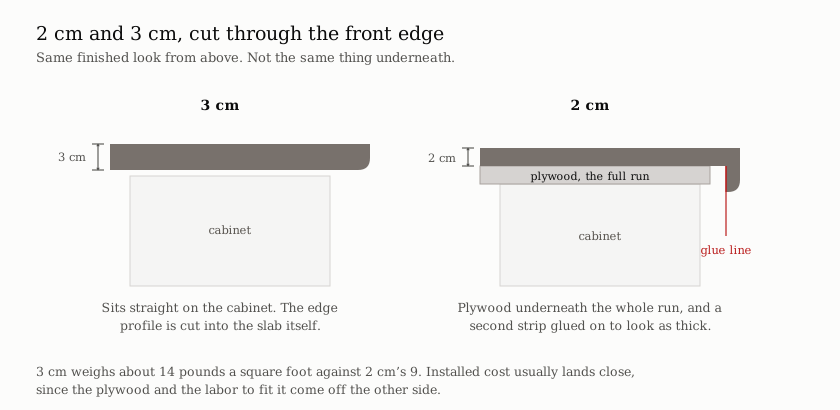
Slabs come in 2 cm (about ¾ inch) and 3 cm (about 1¼ inch), and the difference runs deeper than the edge you see.
A 2 cm slab needs continuous plywood underneath it. On its own the material cracks under stress, especially around the sink cutout, where the cross-section is at its narrowest. It also can't take most edge profiles directly. To get a thick-looking edge on 2 cm, the fabricator laminates a second strip of stone onto the front, and that build-up has a glue line.
A 3 cm slab carries itself. No substrate, the full range of edge profiles cut straight into the material, and roughly 14 pounds per square foot against 2 cm's 9. Material costs more per square foot, but the total installed price often comes out close. The plywood and the labor to install it come off the other side.
Not every material offers both. Caesarstone runs 1.3, 2 and 3 cm; Dekton goes 8, 12, 20 and 30 mm; Neolith reserves its 12 mm for countertops and sends the thinner sheets to walls and floors.
Edges
Thirteen profiles is a normal menu at a fabricator, and the names mean nothing until you've seen them. MSI's edge visualizer lets you pick a profile and a stone and see the two combined — eased, bevel, half bullnose, full bullnose, ogee, dupont, waterfall and the rest, rendered rather than described. Cambria renames all of them (its own sixteen are called things like Ledge, Cascade and Rimrock), which is worth knowing before you assume a brand invented a shape.
Price climbs with machine time. An eased edge is one pass and usually included. An ogee is a compound S-curve that takes several tool changes and far longer to polish. Intricate profiles also chip more often during fabrication, which the shop prices in.
A mitered edge isn't a profile at all. Two pieces get cut at 45 degrees and glued to fake a thicker slab, or to turn the corner and run down to the floor as a waterfall. That consumes extra material and introduces a joint that has to be color-matched. That's why it sits at the top of the price list.
Seams, and the numbers you can hold a fabricator to
Every kitchen longer than a slab gets a seam. Slabs run roughly 120 inches for engineered quartz and up to 138 for some quartzite. Not all of that is usable once cutouts and flaws are worked around, so an island past about ten feet will seam in nearly any material.
What separates a good seam from a bad one is measurable. The Natural Stone Institute's design manual sets a lippage limit of 1/32 inch across a joint, and a flatness tolerance of 1/8 inch in 10 feet for the finished surface. A fingertip finds 1/32 of an inch easily, which makes this one of the few quality standards a homeowner can check without tools. The forensic stone consultants at CTASC publish the tolerances in plain language, including the 1/16-inch gap and 1/8-inch overlap that a stone backsplash is supposed to have.
Where the seam goes is a different question, and there's no standard governing it. Good fabricators avoid centering a seam on a sink cutout — that's where the slab is narrowest, and where water and daily use concentrate. But that's craft judgment rather than a rule, so ask about it rather than assuming. Caesarstone's own writeup on seams names which of its colors hide a joint best; dark, heavily patterned surfaces hide seams, and pale solid colors show every one.
Book-matching is the opposite approach — instead of hiding the joint, you make it the point. Two sequential slabs off the same block get polished on the faces that met, so the veining mirrors across the seam. The Natural Stone Institute has photographs of what that looks like, along with the catches. You're buying two slabs whether or not you need the area, and if one breaks you've lost the pair.
How the sink meets the stone
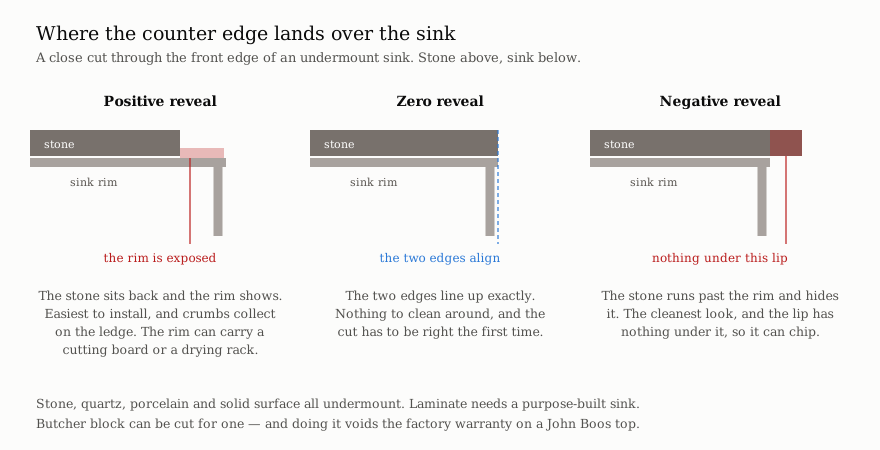
Undermount sinks are set beneath the counter, and there are three ways the two edges can line up:
- Positive reveal — the counter sits back and the sink rim shows. Most forgiving to install, and the exposed ledge collects crumbs.
- Zero reveal — the counter edge lines up exactly with the sink rim. Nothing to clean around, and it demands real precision from the fabricator.
- Negative reveal — the counter overhangs the sink and hides the rim completely. The cleanest look, and that unsupported stone lip is the one most likely to chip.
Not every material undermounts. Stone, quartz, porcelain and solid surface all do. Solid surface goes further and offers an integral sink molded from the same material, with no joint at all. Laminate can undermount now, but only with a purpose-built sink — Formica walks through what that requires, including the flat one-inch resin rim and the acrylic injected around the cut edge to keep water out of the particleboard. Butcher block is the exception worth flagging: cutting a top for an undermount, farmhouse or apron sink voids the John Boos factory warranty outright.
Templating and fabrication
Nobody measures a countertop from the plans. A technician comes out after the cabinets are installed and leveled, with the sink and cooktop physically on site. He records the room as it was actually built: every wall that isn't square, every cabinet run that came in a quarter inch off. Most shops now do this with a laser system rather than a wooden skeleton; the common one holds 1/16-inch accuracy across long runs, which is what makes a 1/32-inch seam possible at the other end.
Fabrication runs about one to three weeks from template to install in normal conditions, and the wait is mostly queue rather than work. Changing your mind after the template restarts the cutting-machine programming and adds days. Spring and summer are the busy season — which in Phoenix overlaps the part of the year you'd least like to be without a kitchen. The timeline article covers how this gap sits inside the rest of the job.
Overhang support
A 12-inch bar overhang is the standard ask, and on 3 cm stone it already exceeds what the Natural Stone Institute recommends. The manual's cantilever guidance puts the unsupported limit at 10 inches for 3 cm and 6 inches for 2 cm, and in no case more than a third of the counter's width. Past that, the stone needs corbels or steel brackets underneath.
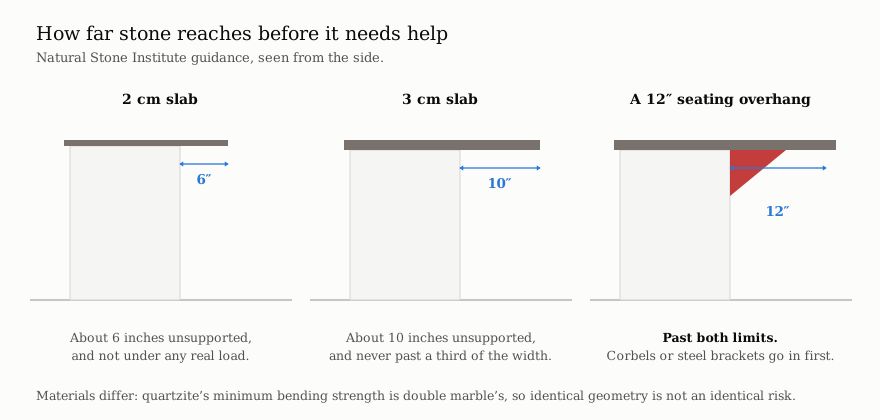
Strength varies enough between materials that the same overhang isn't equally safe in each. Under the ASTM specs, quartzite's minimum bending strength is double marble's — so a marble overhang and a quartzite overhang of the same dimensions are not the same gamble. The islands article covers the seating side of this — how much overhang each counter height actually needs.
What Phoenix water does to a countertop
Phoenix municipal water runs 172 to 302 parts per million of hardness, or 10 to 17.6 grains per gallon, per the city's own water quality report. On the USGS scale, anything above 180 ppm is "very hard." Phoenix water is hard at its softest and very hard across most of its range. Scottsdale publishes its numbers by neighborhood and runs harder still, up to 25 grains south of Indian School Road. Mesa reports 12 to 22, Chandler averages 16.5, and Gilbert comes in softest at 8 to 10.
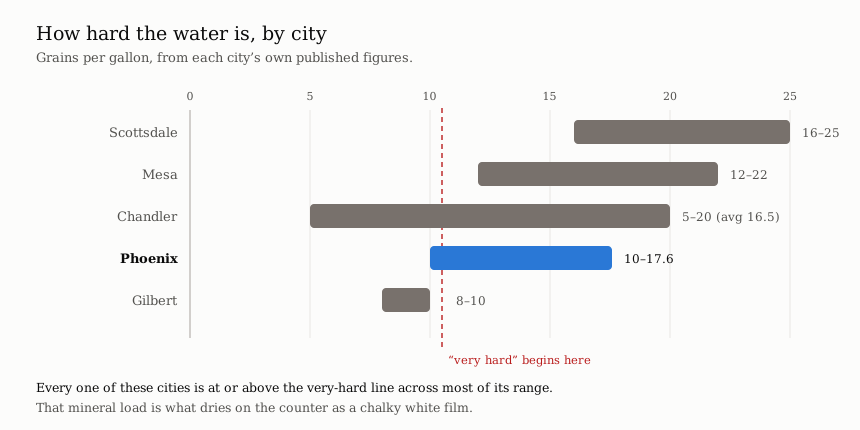
What that means on a counter: when hard water dries, the calcium and magnesium stay behind as a chalky white film. Caesarstone describes the deposits as merging with the surface and becoming more visible over time rather than sitting loosely on top of it.
The awkward part is the remedy. Mineral deposits dissolve in acid, and acid is precisely what damages the two most popular premium surfaces. On marble, acid etches a permanent dull spot. On quartz, MSI warns that a vinegar solution left more than two minutes will eventually etch the resin. The Natural Stone Institute tells stone owners flatly to avoid anything containing lemon or vinegar. Sealing doesn't help either, since a sealer is a repellent that lives below the surface and does nothing about minerals left on top.
Drying the surface is the actual control. That sounds too simple to be the answer, and it is the answer. A matte finish makes it worse rather than better: Vicostone notes that its non-polished finishes show fingerprints and water residue more, which runs against the usual assumption about matte hiding everything.
Sun through the window
Phoenix averages 86 percent of possible sunshine, peaking at 94 percent in June. That's a real consideration for any surface held together by resin.
Vicostone's residential warranty states that direct and constant sun exposure may change the material's appearance and should be avoided, with no exception carved out for windows. Cambria's warranty excludes sunlight along with weather and temperature change, and covers interior use only. Caesarstone takes the softer line, arguing that ordinary window glass mitigates the effect. But its own escape clause is unless it lands directly on your countertops for extended periods — which describes a peninsula under a west window here exactly.
None of that makes quartz a bad choice for a Phoenix kitchen. It makes the window a design question. The options: UV film, a shade, or a material that doesn't care. The other materials article covers the porcelain and sintered options, which are the ones with manufacturer UV testing behind them.
Where to go look at real slabs
A three-inch sample tells you the color and nothing about the slab. Natural stone varies block to block. Even two slabs cut from the same block differ. The Valley has several yards open to homeowners:
- The Stone Collection on South 38th Street keeps a 100,000-square-foot gallery with over 10,000 slabs.
- MSI's Phoenix showroom on West Roosevelt takes walk-ins, though MSI sells through dealers rather than directly, so you look there and buy through a fabricator.
- Arizona Tile stocks slabs locally and posts its quartzite and porcelain inventory online with photos.
- The Yard carries remnants alongside full slabs, which is worth a look for a small kitchen or a single island.
Bring a knife and a glass tile if you're shopping natural stone. The natural stone article explains what to do with them.
Next in the guide: Quartz Countertops · Granite, Quartzite, Marble and Soapstone · Laminate, Wood, Solid Surface and Porcelain
Related: Where the Money Goes · Choosing a Kitchen Layout · Kitchen Cabinets · The Kitchen Remodel Timeline
Common questions
- What is the most popular kitchen countertop material?
Engineered quartz. It's non-porous, never needs sealing, and shrugs off acid — but the resin that binds it is vulnerable to heat and to sustained direct sunlight.
- Do I need 2 cm or 3 cm countertops?
3 cm carries itself and takes any edge profile directly. 2 cm needs plywood underneath and a laminated strip to build up a thick-looking edge. Installed cost often lands close.
- How thick can an overhang be without support?
10 inches on 3 cm stone, 6 inches on 2 cm, and never more than a third of the counter's width. A 12-inch bar overhang needs corbels or brackets.
- Will my countertop have a seam?
Any run longer than a slab will. Slabs top out around 120 to 138 inches, and not all of that is usable, so an island past about ten feet seams in nearly any material.
- Why does my countertop get white spots in Phoenix?
Phoenix water carries 10 to 17.6 grains of hardness per gallon. When it dries, the minerals stay behind as a chalky film. Drying the surface is the fix — acid dissolves the deposits but damages marble and, over time, quartz resin.
- When does the countertop get measured?
After the cabinets are installed and leveled, with the sink and cooktop on site. Nobody templates from drawings, because the room is never exactly what the drawings said.