Kitchen Appliances
Kitchen Remodeling: A Complete Guide
Appliance shopping feels like the fun part, and it is — right up until someone discovers the cabinets were ordered around the wrong refrigerator. Appliances get chosen before cabinets for a reason, and the reason is arithmetic: the size on the box is not the size anyone builds to.
Cabinets get built around appliances, not the other way round
Choose appliances first. The number on the box is not the number the cabinet shop needs. A "30-inch" wall oven has a cutout between 28½ and 28⅝ inches wide. It needs roughly a 33-inch cabinet to live in. A 27-inch oven wants about a 30-inch cabinet. Whirlpool publishes the full cutout table. Order cabinets against a guess and you pay for it. Either a cabinet gets re-ordered, or you live with a filler strip where the oven doesn't quite fit.
The common sizes:
| Appliance | Nominal size | What actually matters |
|---|---|---|
| Wall oven, 30-inch | 30 in. | Cutout 28½–28⅝ in.; needs ~33-in. cabinet |
| Wall oven, 27-inch | 27 in. | Needs ~30-in. cabinet |
| Dishwasher | 24 in. wide × 24 deep | 18-in. compact option exists |
| Over-the-range microwave | 30 in. wide | Mounts 30 in. from cooktop to top of cutout |
| Counter-depth refrigerator | "counter depth" | Depth quoted excludes doors and handles |
Counter-depth refrigerators are the dimension people misread. The quoted depth is the cabinet box excluding doors and handles. Whirlpool lists three separate depths for exactly this reason. The door slab and handle still project past a 24-inch cabinet, so "flush with the counters" was never quite the promise.
Panel-ready refrigeration is the extreme version of appliances-first. Sub-Zero's design guide caps the door panel a cabinet shop can build at 75 pounds for a built-in and 65 pounds for an integrated column. It sets a minimum panel thickness of ⅝ inch for flush-inset and integrated units. It requires four inches of clear venting below the panel, with removable base molding. Those are cabinet-shop specifications published by an appliance manufacturer, which tells you which decision comes first.
Gas, electric, or induction
Induction is the fastest, coolest, and most efficient of the three, and the cookware rule is one sentence: any flat-bottomed pan a magnet sticks to will work. Aluminum, copper and most glass won't. Induction cooks by generating a magnetic field that creates heat inside the pan itself, per the Department of Energy's explainer.
The efficiency gap is federally documented. ENERGY STAR puts induction at about 85 percent of heating energy reaching the food, against roughly a third for gas. Conventional electric sits in between at 74 to 85 percent. Both federal sources agree it boils water noticeably faster than gas or radiant electric, and the surface stays comparatively cool. Their exact speed figures disagree; that's in The deeper detail.
On gas and health: the research is real, the headlines overstate what was measured, and the practical answer is ventilation. A 2024 Stanford study measured nitrogen dioxide in more than 100 homes. Typical gas or propane use raised annual exposure by about 4 parts per billion, with small homes hit hardest. A separate 2023 study found gas burners emitting 10 to 25 times more benzene than electric coils. Induction was indistinguishable from zero. The Stanford lead author's own summary: how much gas you burn matters most. After that, whether you have an effective range hood and whether you use it. What those studies did and didn't measure is in The deeper detail below.
The pacemaker question has a short answer: follow your device manufacturer's guidance, and center the pan on the coil. The only real study found interference required an unusual combination of conditions, and modern devices are overwhelmingly the low-risk type. The study's specifics are in The deeper detail.
The hood over your cooktop
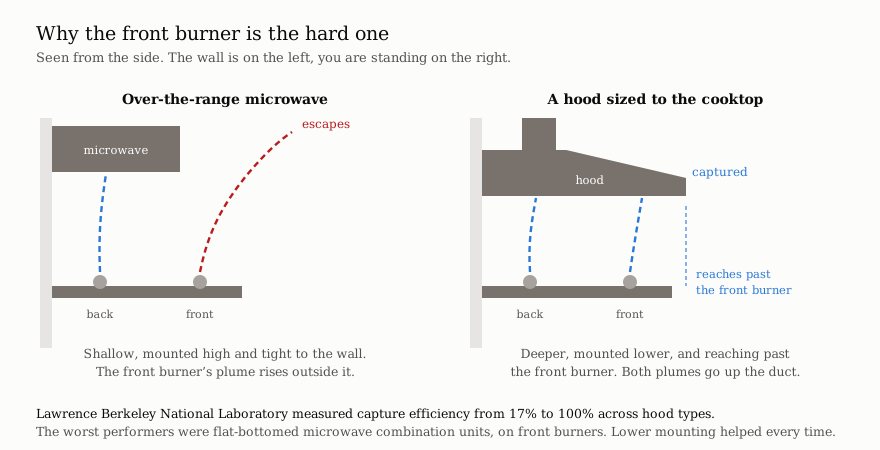
Get a hood at least as wide as the cooktop, mount it low, and duct it outside through smooth metal pipe. Those three choices matter more than the brand. Lawrence Berkeley National Laboratory has spent years measuring what hoods actually capture. Three things improved capture consistently: a hood that covers more of the front burners, a lower mounting height, and more airflow.
The worst performer in LBNL's testing is the most commonly installed one: the flat-bottomed over-the-range microwave, especially with front burners in use. Front burners are the hard case for every hood. The plume has further to travel and more room to drift.
Downdraft systems test poorly for the reason you'd expect: the exhaust sits level with or below the heat, and hot air goes up.
Recirculating hoods are not ventilation. The Home Ventilating Institute says so flatly. Moisture, heat and combustion gases go straight back into the room by definition, and the measured filter numbers (in The deeper detail) are worse than the marketing.
Sizing rules of thumb are manufacturer guidance rather than code. Broan's version — 100 CFM per 10,000 BTU of gas output, and 350 to 500 CFM for electric or induction — is at least attributable to a manufacturer. The "100 CFM per linear foot" rule you'll see everywhere traces to no standards body at all. Code sets the floor much lower: 100 CFM intermittent, or 25 CFM continuous.
The install details that decide whether any of it works:
- Duct must be smooth metal. The code prohibits flexible and corrugated duct outright, with a minimum of 3¼ by 10 inches rectangular or 6 inches round. The ridges in flex duct create turbulence and cut airflow.
- Mount 18 to 30 inches above the burners. Lower captures better; 18 inches is the code floor above an open flame.
- Islands need more capacity than a wall installation. There's no wall to contain the plume, and the hood usually mounts higher.
- Judge noise in sones, not decibels. The scale is linear — a 6-sone fan is twice as loud as a 3-sone fan, and one sone is about a quiet refrigerator. Certified ratings live in HVI's product directory, not on the marketing card.
Crossing 400 CFM changes the job. Above that, code requires a makeup-air system. It keeps the house from going negative and pulling combustion gases back down a water heater flue. In Phoenix that means tempering outside air that can be 110 degrees. Most 36- and 48-inch pro-style hoods cross the line. The makeup-air assembly is a real cost that gets discovered late. The islands article covers the same trigger from the island side.
What the appliances ask of your panel
The code requires at least two 20-amp small-appliance circuits serving the kitchen, feeding nothing else in the house. That baseline hasn't changed in decades.
What changed is shock protection, and Phoenix homeowners are feeling a six-year jump. The city moved to the 2023 NEC on August 1, 2025 under Ordinance G-7397, having skipped the 2020 edition entirely. GFCI protection now covers all kitchen receptacles, not only the ones at the counter. And it extends to appliances rated 150 volts or less to ground and 60 amps or less, hardwired equipment included. In practice that means dual-function breakers on circuits that used to take plain ones. They cost more and trip more readily in the first month; expect it.
Pull the install manual before the electrician roughs in, because manufacturers often ask for more than code. Sub-Zero specifies a dedicated 15-amp circuit serving only the refrigerator, where code would permit sharing. And circuit sizes for an electric range or induction cooktop vary too much by model for any article to hand you a number. That figure comes off the specific model's installation manual. Another argument for choosing the appliance before the wire goes in the wall. The lighting and electrical article covers what a panel can actually absorb.
Dishwashers
Buy the stainless tub, and treat the decibel number on the card with suspicion. Consumer Reports declines to publish a "quiet" threshold at all and says manufacturer decibels aren't necessarily the best indicator. They score the peak noise across a full cycle instead, on the reasoning that what you remember is the loudest moment.
A stainless tub is more durable than plastic, stains less, and helps dishes dry faster. The drying connection: a condensation dishwasher relies on the cool stainless wall pulling moisture off the load. That works on glass and ceramic, and does poorly on plastic. Bosch's zeolite system attacks the same problem with minerals that convert moisture into heat. It claims 60 percent better drying than its own previous technology — a comparison to itself, note, not to competitors.
Specify the counter air gap for the drain. Phoenix adopted more than one plumbing code, and they disagree. One requires the air gap fitting; the residential code accepts a high loop. The air gap satisfies both, which makes it the safe specification. The sinks and faucets article covers it in full.
Money, honestly
ENERGY STAR now certifies cooktops and ranges, including induction, under a specification that took effect in September 2023. Certified models average about 18 percent more efficient. Standalone wall ovens are excluded, and so are all gas cooking products.
Beyond that, the incentive picture in Phoenix is thin, and it's more useful to say so than to send you looking. The federal energy-efficient home improvement credit terminated for property placed in service after December 31, 2025. SRP's residential rebate list covers air conditioning, insulation, ducts, shade screens, windows and thermostats — no kitchen appliance rebates. APS runs its own marketplace and rebate programs worth checking against your account.
On lead times: stock appliances from mainstream brands move fast now. Special-order and premium built-in lines don't. They're exactly the ones that hold up a cabinet install. Ask your dealer for their current number rather than trusting an article — including this one.
The deeper detail
The sourcing and fine print behind the short versions above:
- Induction speed. The two federal sources disagree on the exact figure: DOE says induction boils water 20 to 40 percent faster than gas or radiant electric, while ENERGY STAR says less than half the time. Either way, noticeably faster.
- The gas-and-health studies. The 2024 Science Advances paper from Stanford placed sensors in more than 100 homes and measured nitrogen dioxide before, during and after stove use — the 4 parts per billion figure is measured. The widely quoted asthma and mortality figures from that paper are modeled attributions: the researchers applied published exposure-response functions to modeled national exposures, not counted cases in the homes they measured. Homes under 800 square feet saw roughly double the national average exposure. The 2023 benzene study measured emissions and concentrations from 87 homes, and its own authors wrote that further research is needed to assess actual exposures and health impacts.
- The pacemaker study. Published in 2006: 244 explanted pulse generators tested against 11 induction cooktops. Interference required a specific combination — the patient standing very close, the pot off-center on the coil, an older unipolar left-side implant, and a device among the most sensitive 15 percent. At 35 centimeters, induced voltages were negligible under every condition. Modern devices are overwhelmingly bipolar, which the study identified as the low-risk configuration. Centering the pan was the researchers' own recommendation.
- LBNL's capture numbers. Capture efficiency across hood types ran from 17 to 100 percent. With two front burners in use: 63 to 95 percent captured, against 74 to 99 percent when one burner was at the back.
- Recirculating filter performance. About 30 percent of fine particulates removed, and a fresh carbon filter taking out around 60 percent of nitrogen dioxide — dropping to roughly 20 percent within a few weeks.
Related: Kitchen Remodeling Guide · Lighting and Electrical · Kitchen Islands · Where the Money Goes · The Kitchen Remodel Timeline
Common questions
- Why do I have to pick appliances before cabinets?
Because cabinets get built to appliance dimensions, and nominal sizes lie. A "30-inch" wall oven has a 28½-inch cutout and needs a 33-inch cabinet. Panel-ready refrigerators go further and cap what the panel can weigh.
- Is a counter-depth refrigerator actually flush with the counter?
No. The quoted depth is the cabinet box without doors or handles, so the door slab and handle still project past the counter edge.
- What cookware works on induction?
Anything flat-bottomed that a magnet sticks to. Aluminum, copper and most glass won't work.
- How many CFM does my range hood need?
Broan's guidance is 100 CFM per 10,000 BTU of gas output, or 350 to 500 CFM for electric and induction. Above 400 CFM, the code requires a makeup-air system, which is a separate mechanical install.
- Is an over-the-range microwave a good range hood?
It's the worst-performing configuration Lawrence Berkeley National Laboratory tested, particularly on front burners, because the flat bottom sits high and close to the wall.
- Do recirculating hoods work?
Not for ventilation. The Home Ventilating Institute says they provide no real ventilation, and measured carbon-filter performance on nitrogen dioxide falls to about 20 percent within weeks.
- Are there rebates on kitchen appliances in Phoenix?
Essentially none. SRP has no appliance rebates and the federal home improvement credit ended for anything placed in service after December 31, 2025.