Hiring a Remodeling Contractor in Arizona
Kitchen Remodeling: A Complete Guide
At some point this stops being about kitchens and becomes about trust: a stranger, your house, and a large check. Arizona gives you real protections here — a license, a bond, a recovery fund — but each is narrower than it sounds, and every one of them depends on paperwork you keep from the first day.
Each of those has a section below explaining why.
What the license is, and what it isn't
Check the classification, not just the license. Arizona licenses contractors through the Registrar of Contractors. A full-scope remodeler holds a B (General Residential) or B-3 (General Remodeling and Repair) license. Smaller operators may hold R-61 or R-62. R-61 is capped at $50,000 per project including labor and materials; R-62 is capped at $5,000. Those caps sit on the ROC's own classification list, and they're the most useful thing on it. An R-62 holder cannot lawfully take on a $60,000 kitchen, no matter how good the bid looks.
A B or B-3 license doesn't cover everything either. Electrical, plumbing, mechanical, pool and well work all go to separately licensed trades. That's not a loophole; it's how the classification system works.
You can look up any license free at the ROC's contractor search. It shows status, classification, bond and complaint history. One caveat: the ROC's own FAQ states that complaints appear for two years from the date the case closed. A contractor with a disciplinary history from 2021 can show clean today.
"Licensed, bonded and insured" is three claims, and Arizona verifies about one and a half of them.
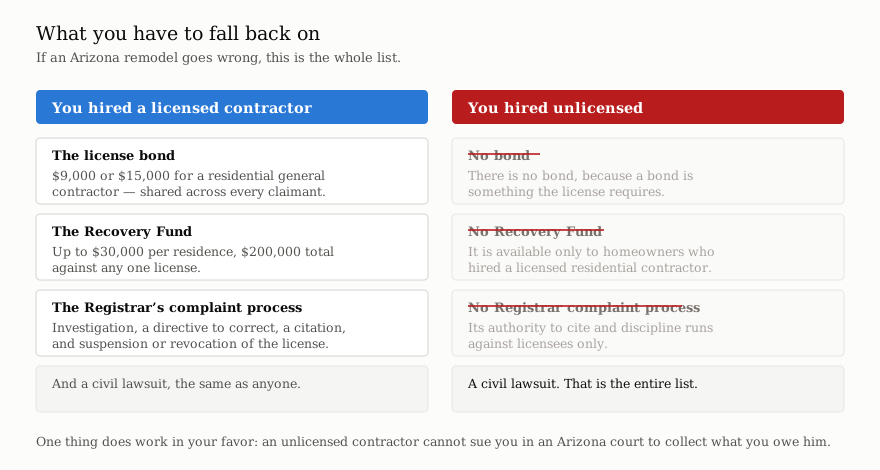
The bond is real but small. A residential general contractor doing under $750,000 a year posts a $9,000 bond; above that, $15,000. Residential specialty licenses run $4,250 or $7,500. That amount is the entire pool available to every claimant against that license, not an amount per homeowner. On a $90,000 kitchen gone wrong, a $9,000 bond is about ten cents on the dollar. Bond claims also have to be brought within two years of the act.
"Insured" is the gap. Arizona's licensing statute requires an attestation that the applicant complied with workers' compensation rules. It does not require general liability insurance at all, and the ROC does not verify it. The state checked the bond, took the contractor's word on workers' comp, and never looked at general liability. Verifying that one is entirely on you. The six-step check is below.
The Recovery Fund, and the sentence that makes it matter
Arizona runs a Residential Contractors' Recovery Fund for homeowners damaged by a licensed contractor's conduct. The numbers: up to $30,000 per residence, and $200,000 total against any one contractor's license, after which remaining claims are paid pro rata.
Here is the sentence that matters more than the numbers. The Fund applies only if you hired a licensed contractor. Repair and completion bids submitted with a claim also have to come from licensed people. Hire unlicensed and there is no Fund, no bond, and no ROC complaint process, because the ROC's authority runs against licensees.
Eligibility: you must be an owner occupying the property as your primary residence, or a qualifying trust, LLC member or lessee. Rental and investment property is excluded outright.
There are two routes in. The administrative route requires that your ROC complaint ended in the license being suspended or revoked. It also requires that you filed a bond claim first and carried it to a final determination. The civil route requires a court judgment. Either way you'll need four documents the ROC lists by name: the property deed, the original contract, proof of payment, and proof of the cost to repair or complete. Every one of those is something you create and keep at the front of the job. A homeowner who paid cash with no written contract cannot make a claim, even when everything else lines up.
What Arizona requires to be in your contract
Most people don't know this exists. A.R.S. § 32-1158 requires that any contract over $1,000 between a contractor and a property owner contain, in writing:
- The contractor's name, business address and license number
- Your name and mailing address, and the jobsite address
- The contract date and an estimated completion date
- A description of the work
- The total dollar amount for all work
- The advance deposit amount
- Progress payment amounts and the construction stages they attach to
- A notice of your right to file a complaint with the Registrar, with contact information and the time limit — in at least ten-point bold type, signed by both parties
The contractor also has to hand you legible copies of everything signed, plus a written signed receipt showing the actual cash amounts received.
That ten-point-bold complaint notice is a red flag you can check in ten seconds. If it isn't in the contract, the contractor either doesn't know the statute or is choosing to ignore it.
One thing to understand about the statute: a contract missing the required terms is still enforceable against you. The requirements are a licensing standard the ROC can discipline against, not a rule that voids the agreement.
On the down payment: no more than a third, and never in cash. Arizona sets no statutory cap. The Attorney General's guidance is to pay no more than a third up front and tie the rest to completed work. Hold the final payment until you know subs and suppliers have been paid. The FTC adds the payment-method rule: check or credit card, never wire transfer, gift card, payment app, cryptocurrency or cash. There's a practical reason beyond fraud: a Recovery Fund claim requires documented proof of payment.
On the cooling-off period: Arizona gives you three business days to cancel a home solicitation sale — one where a seller showed up without a prior invitation. If you called three remodelers for bids and signed at your own kitchen table, that right generally doesn't attach, because the contractor came by invitation.
Liens, and the Arizona protection most people have never heard of
The classic horror story: your tile subcontractor doesn't get paid and puts a lien on your house. In Arizona, for an owner-occupied home, that story is substantially blocked by statute.
A.R.S. § 33-1002 says a mechanic's lien cannot be recorded against an owner-occupant's home unless the claimant signed a written contract directly with the owner-occupant. To qualify, you must be a natural person who held recorded title before work began. You must also live, or plan to live, in the home at least 30 days in the year after completion, without intent to sell or lease. The protection can't be waived — any agreement purporting to waive it is void.
What that leaves: your general contractor, who does have a direct written contract with you, can still lien. The protection may not apply to a rental, a flip, an investment property, or a home you haven't occupied. And it bars the lien, not the lawsuit — a sub can still sue the general contractor.
Twenty-day notices are normal, not threatening. Anyone furnishing labor or materials must send you a preliminary notice within 20 days of first delivering to the jobsite. Failing to send one invalidates any later lien. Treat these as free information: they tell you exactly who is working on your house. Keep every one, and use the stack as your checklist of parties to collect lien waivers from.
Lien waivers only work in the statutory forms. Arizona publishes four of them: conditional and unconditional, progress and final. Anything else is unenforceable. Collect conditional waivers at each progress payment and unconditional final waivers at the end. Read the warning on the unconditional form before signing one — it's enforceable against you even if you haven't been paid.
Insurance, and how to actually check it
General liability covers damage the contractor's work does to your property, and injury to other people. Workers' compensation covers the contractor's own employees if they're hurt in your house. Arizona requires workers' comp of any employer who regularly hires workers, regardless of headcount — there's no small-employer exemption.
Why verify: if an uninsured worker is hurt on an uninsured employer's job, Arizona law strips the employer of its usual defenses. It treats proof of injury as prima facie evidence of negligence. That's aimed at the employer, not you. But a worker with no coverage and no solvent employer has every reason to pursue the homeowner's policy instead. That's the practical reason to verify rather than assume.
Verifying takes about fifteen minutes, the same six steps every time:
- Ask for the certificate of insurance to come directly from the agent or carrier, not forwarded by the contractor. A certificate is a PDF, and PDFs are easy to edit.
- Ask to be named as certificate holder, so the carrier notifies you if the policy is cancelled.
- Check the effective and expiration dates against your project's start and finish. A policy that expires mid-job is worth nothing at the end of it.
- Confirm both general liability and workers' compensation appear, with liability limits that make sense against the value of your house.
- Call the carrier at the number printed on the certificate — not a number the contractor gives you — and confirm the policy is in force.
- Ask whether subs are covered under the general contractor's policy or carry their own, and get certificates for any who carry their own.
If your house was built before 1978
The EPA's Renovation, Repair and Painting rule applies to any home built before 1978 where paid work disturbs painted surfaces. Arizona is a state where the EPA administers the rule directly. The exemption covers work disturbing six square feet or less of interior painted surface per room, with no window replacement and no demolition. A kitchen remodel passes that threshold in the first hour.
A compliant firm does two things before starting. It holds a current EPA firm certification, which you can verify through the EPA's lead-safe firm search. And it hands you the EPA's Renovate Right pamphlet no more than 60 days before work begins, and gets your written acknowledgment.
If a contractor bidding a pre-1978 house never mentions either one, that's information. He's out of compliance with federal law before the first cabinet comes off the wall, which suggests how the rest of the job will be run.
Asbestos is the other pre-1980 concern: popcorn ceilings, vinyl floor tile, and the black mastic under it. Maricopa County generally exempts owner-occupied single-family homes from its asbestos notification requirements, which target commercial and larger multifamily projects. That's a regulatory threshold, not a safety opinion. If your house is that vintage and has any of the three, have the material tested by an accredited lab before demolition, and get the contractor's handling plan in writing.
Who pulls the permit
The permit belongs on the license of the person doing the work. A contractor who asks you to pull it is telling you something. The reason is on the City of Phoenix permit application itself.
The application has a line for the contractor's ROC license number. The alternative is an owner-builder declaration reading: as property owner, I am not required to use a licensed contractor because the property is intended for my sole occupancy and will not be offered for sale or rent within one year of completion.
Signing that means declaring, to the city, that no licensed contractor is required on this job. It strips out the license, the bond, the Recovery Fund and the ROC complaint process all at once. It moves responsibility for code compliance and scheduling inspections onto you. And because selling or renting within a year is prima facie evidence the work was for profit, it creates a real problem if your circumstances change.
Phoenix requires permits for a kitchen remodel in almost every real case. Relocating a sink, adding or moving electrical circuits, moving mechanical equipment, or removing a wall each trigger one on their own. You can independently confirm a permit was pulled, whose name it's under, and whether inspections passed through the city's permit search — a free verification tool almost nobody knows exists.
Comparing bids
Get three, and read past the total. The FTC's guidance is to be wary of the lowest bid until you understand why it's lowest. The Arizona Attorney General's red-flag list is short and accurate: door-to-door solicitation, high-pressure sales, and demanding full payment up front, particularly in cash.
What separates a readable estimate from an unreadable one: whether the work is itemized, whether the allowances are stated, and whether it contains the nine things § 32-1158 requires. The where the money goes article covers how allowances quietly move a bottom line.
The ROC publishes its own guidance for homeowners before hiring. It's worth reading in full — it's written by the agency that would handle any complaint you filed.
If something goes wrong
File with the ROC, and mind two deadlines. For a remodel, the complaint window is two years from the date work was last performed. And for a workmanship complaint, the ROC cannot cite a contractor unless he was given the chance to inspect the work within 15 days of written notice.
That second one has a consequence people learn too late: don't tear out the defective work before the contractor has had his look. However satisfying it would be, demolishing the evidence removes the ROC's authority to act on it.
Know what the ROC can't do. It can investigate, direct a correction, cite, refer to a hearing, and suspend or revoke a license. That last one is what opens the Recovery Fund. It cannot adjudicate liens, cannot act as your attorney, and cannot recommend a contractor to you, which it declines on conflict-of-interest grounds. Filing a complaint is at roc.az.gov.
Related: Kitchen Remodeling Guide · Where the Money Goes · Your Kitchen Decision Checklist · The Kitchen Remodel Timeline
Common questions
- How do I check a contractor's license in Arizona?
Free, at the ROC's contractor search. It shows license status, classification, bond and complaint history — though closed complaints only appear for two years.
- What does a contractor's bond actually cover?
Less than people assume. A residential general contractor's bond is $9,000 or $15,000, and that's the whole pool shared across every claimant against that license, not an amount per homeowner.
- Is the Arizona Recovery Fund available if my contractor wasn't licensed?
No. The Fund, the bond and the ROC's complaint process all require a licensed contractor. That's the strongest practical argument for checking the license before you sign.
- How much can I recover from the Recovery Fund?
Up to $30,000 per residence, and $200,000 total against any one contractor's license. Beyond that, claims are paid pro rata.
- Can a subcontractor put a lien on my house in Arizona?
Generally not, if you're an owner-occupant and they had no direct written contract with you. Your general contractor still can, and the protection may not apply to a rental or a home you haven't occupied.
- Should I pull the permit myself?
No. The Phoenix application's owner-builder declaration states that no licensed contractor is required on the job. That removes the license, the bond, the Recovery Fund and the complaint process, and puts code compliance on you.
- How much of a down payment is reasonable?
Arizona sets no cap. The Attorney General recommends no more than a third, with the rest tied to completed stages of work.