How to Judge Cabinet Quality
Kitchen Remodeling: A Complete Guide
The showroom will tell you everything about the finish and almost nothing about what's underneath it. Underneath is where the money went — or didn't — and you can check most of it yourself in about ninety seconds, no salesperson required.
What the box is made of
Three materials show up in cabinet boxes, and the ranking isn't as simple as showrooms make it sound.
Particleboard is wood chips and resin. It's dimensionally stable, cheap, and takes a laminate face well. Its weaknesses are screw holding — strip a hinge screw and the hole is done — and water. A leak under a sink base will swell particleboard permanently.
MDF is finer and denser than particleboard, machines cleanly, and takes paint better than anything else. It's heavier and still vulnerable to standing water.
Plywood holds screws better, survives a leak, and weighs less than particleboard of the same thickness. It's the right answer for sink bases regardless of what the rest of the kitchen uses.
Thickness matters as much as material. Half-inch sides are common at the low end; three-quarter-inch is what you want, particularly on frameless construction where the box panels are the structure.
The MDF surprise: for painted doors, MDF is genuinely better than solid wood. It has no grain to telegraph through paint and no seasonal movement, which means no hairline cracks at the joints. That's not a downgrade — it's the correct material. More on why that matters in Phoenix below.
Framed, frameless, or inset
Three ways to build the front of a cabinet, and the choice affects how much you can actually fit inside.
Face-frame construction glues a hardwood frame — rails and stiles, typically 1½ inches wide — to the front of the box. It's forgiving of out-of-square walls, gives hinges a solid mounting surface, and hides imperfections well. The cost is opening size: on a 15-inch base cabinet, those stiles eat about 3 inches of clear width. That's roughly 20 percent of the front, and it means narrower drawer boxes.
Frameless, also called European or full-access, skips the frame entirely. The box panels carry the load and doors mount to hinges bored into the side panels. You get the full box width as usable opening, wider drawers, and better reach to the back — typically 10 to 15 percent more usable volume in the same footprint. The trade-off is that it's unforgiving. With tight reveals and full-overlay doors, Fine Homebuilding's installation guide makes the point plainly: every imperfection shows, so the install has to be dead level and plumb.
Inset doors sit flush inside the face frame rather than overlaying it. It's the most furniture-like look and historically correct for older homes. It's also the most expensive, gives the smallest opening of the three, and is the construction most punished by seasonal movement. In Phoenix the failure mode is gapping rather than binding — a door set to a tight reveal in a humid month opens up noticeably as the wood dries out.
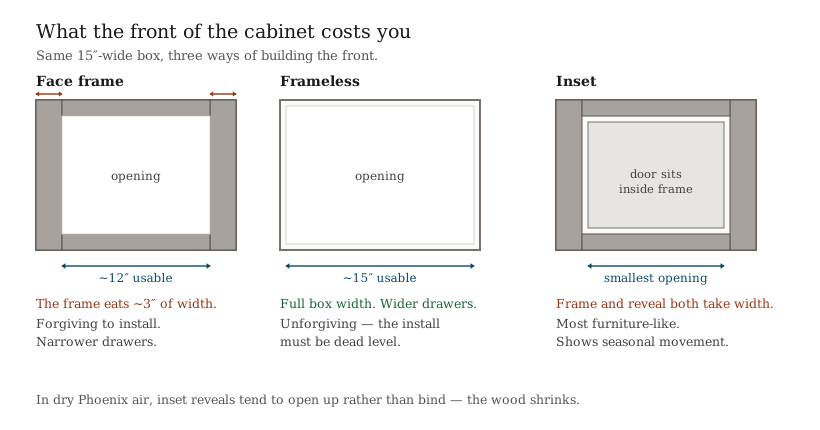
To see it in finished kitchens rather than diagram form, Fabuwood photographs framed against frameless, and Houzz has a filtered gallery of inset kitchens where the flush reveals are easy to spot.
Drawers tell you the most
If you check one thing in a showroom, check a drawer.
The box: dovetailed solid wood is the best construction — interlocking joints that can't pull apart. Doweled solid wood is acceptable. Stapled particleboard is the tell that everything else was built to a price. Look for solid maple or birch, five-eighths to three-quarters of an inch thick, with the bottom seated in a routed groove rather than stapled underneath.
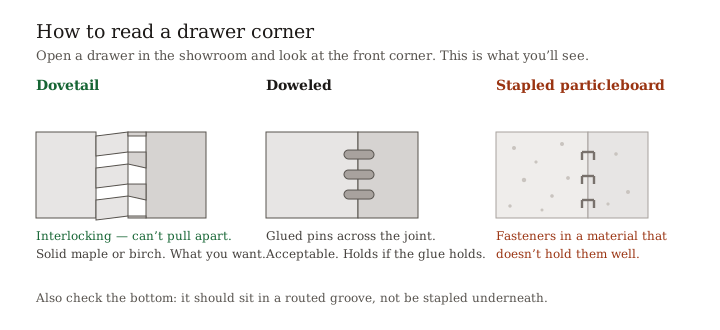
The glides: full-extension undermount soft-close is the current standard and worth having. It pulls the drawer all the way out so you can reach the back, hides the hardware, and rates around 100 pounds. Side-mount ball-bearing glides that only pull three-quarters of the way out are a step down — the back of that drawer becomes storage you forget about. Rockler photographs the three mounting types with a drawer actually installed on each, which makes the difference obvious. Blum is the reference brand; seeing their hardware in a cabinet is a good sign.
Hinges: concealed European cup hinges with six-way adjustment are standard now. The adjustment matters more than people realize — it's how doors get realigned when a house settles or wood moves. Blum's hinge line is what better cabinets use.
The certification worth asking about
ANSI/KCMA A161.1 is the industry's durability standard, and it's tier-agnostic — a stock line can carry it and a custom shop can't.
The testing is specific: shelves loaded at 15 pounds per square foot for seven days, wall cabinets holding 600 pounds, drawers cycled 25,000 times under load, doors cycled 25,000 times plus a 65-pound load, and finishes tested from 120°F down to −5°F and against household spills. Between 40 and 50 percent of manufacturers fail their first attempt, usually on structural integrity or mechanical endurance.
What it proves is that the cabinet survives normal use. What it doesn't tell you is anything about finish beauty, wood grade, or whether the company will honor a warranty. It's a floor, not a ceiling — but it's an objective one, and "is this line KCMA-certified?" is a question any showroom can answer immediately.
The 90-second showroom inspection
Walk up to a display cabinet and do this:
Open a drawer all the way. Does it come fully out, or stop three-quarters? Look at the corner joint — dovetail, dowel, or staples?
Push the drawer closed and let go. Soft-close should catch it quietly.
Grab the cabinet by its front edge and try to rack it side to side. A well-built box barely moves.
Look at the back panel. A thin hardboard back stapled on is weaker than a full three-quarter-inch back with hanging rails.
Open a door and look at the hinge. Is it adjustable in three directions?
Reach inside and check the shelf. Half-inch shelves on a 36-inch cabinet will sag under dishes within a few years.
Finally, ask what the box is made of, and don't accept "all wood construction" as an answer — particleboard and MDF are technically wood products, so that phrase can mean almost anything. Ask specifically: particleboard, MDF, or plywood, and how thick.
What Arizona does to cabinets
This is where a Phoenix kitchen genuinely differs, and it changes what you should specify.
Wood settles to the moisture content of the air around it. The USDA's wood handbook — the reference document on this — targets 8 percent for interior woodwork in most of the country and 6 percent in the dry Southwest. Afternoon humidity here runs in the teens for much of the year.
A cabinet built at 8 percent and shipped to Phoenix loses roughly half a percent of its cross-grain width as it dries out. On an 11-inch raised door panel that's about a sixteenth of an inch of total shrinkage, split between both sides.
That small number causes three specific, predictable problems:
The unfinished panel line. A solid-wood center panel gets finished after the door is assembled, so the strip hidden inside the frame groove is bare wood. When the panel shrinks, that bare strip emerges. On a stained door it reads as a light line — noticeable, often accepted as character. On a painted door it appears as a bare or primer-colored line against the paint, and it's the single most common warranty call in this climate. It isn't a defect, and essentially every manufacturer warranty excludes it.
Showplace, a cabinet manufacturer, photographs both versions — the same shrinkage on a stained door and on a painted one. The difference in how obvious it looks is the whole argument for MDF panels, and it's easier to see than to describe.
Hairline cracks at painted door joints. Where a Midwest kitchen might show these after a few years, Phoenix commonly shows them in the first season. The Cabinet Joint has a close-up with arrows marking which way the grain is pulling, captioned as a normal hairline crack that isn't covered under warranty — even on a door that arrived that way.
Inset doors gapping. A reveal set tight will open up visibly as the wood dries.
What to specify instead
For painted cabinets, ask for MDF center panels. MDF doesn't move seasonally, so there's no shrink line and no joint cracking. This is the single most useful cabinet decision you can make in Phoenix, and it costs nothing extra on most lines.
For stained cabinets, solid wood panels are fine and preferable — the shrink line barely shows against stain, and you keep the grain. Ask for quartersawn stock on wide panels if it's offered; it moves about half as much as flat-sawn.
Two more worth asking about: whether every face of the doors and exposed panels is finished (finishing one side only causes cupping), and whether the cabinets can sit in the conditioned house for a few days before installation. Never let them wait in a Phoenix garage — summer conditions in there are brutal.
One exception to flag: if your house runs an evaporative cooler rather than refrigerated air, indoor humidity swings from very dry to very humid seasonally. That's a much harder cycle for cabinetry. Inset doors are a poor choice, and MDF panels on painted doors move from recommended to necessary.
Next: Door Styles
Related: Kitchen Cabinets · Stock, Semi-Custom, or Custom · Storage and Hardware
Common questions
- Are plywood cabinets better than particleboard?
For screw holding and water resistance, yes — and plywood is the right call for a sink base regardless of the rest. For dimensional stability, particleboard and MDF are actually better. Thickness matters too: three-quarter-inch beats half-inch.
- What's the difference between framed and frameless cabinets?
Framed cabinets have a hardwood frame across the front, which is forgiving to install but costs you about 20 percent of the opening width. Frameless has no frame, giving fuller access and wider drawers, but demands a precise installation.
- What is KCMA certification?
An industry durability standard involving 25,000-cycle door and drawer testing, shelf and wall-cabinet load tests, and finish resistance testing. It applies across all tiers, and 40 to 50 percent of manufacturers fail their first attempt.
- Does "all wood construction" mean solid wood?
No. Particleboard and MDF are wood products, so the phrase can describe almost any cabinet. Ask specifically what the box is made of and how thick it is.
- Should painted cabinets have MDF or solid wood panels in Arizona?
MDF. Solid wood panels shrink in dry desert air and expose an unfinished line at the panel edge, which shows starkly against paint and isn't covered by warranty.
- What fails first on a cheap cabinet?
Drawer glides and hinge screws, usually — stripped screws in particleboard, and drawers that stop sliding smoothly. Sagging shelves come next.