Granite, Quartzite, Marble and Soapstone
Kitchen Remodeling: A Complete Guide
Standing in a slab yard, you're surrounded by beautiful rock wearing names that promise more than they mean. The four stones in this guide behave nothing alike — one takes a skillet straight off the burner, another dulls at the touch of lemon juice — and the tag won't reliably tell you which one you're looking at. Your own hands can, in about fifteen minutes.
The names on the tags are commercial, not geological
The Natural Stone Institute concedes it directly: the stone industry loosely accepts various granite-like stones under the label "granite," including gneiss and other quartz-based rocks. "Quartzite" is worse, and we'll get to it. Names like Super White and Fantasy Brown tell you what a slab looks like, not what it's made of. Price and country of origin are no help either.
That matters because the four stones below fail in completely different ways. One etches on contact with lemon juice. One will happily take a skillet straight off the burner. Buying by name means finding out which is which after installation.
Granite
Igneous rock: hard, heat-tolerant, and porous to a degree that varies enormously from stone to stone. The Natural Stone Institute's observed range for granite absorption is 0.02 to 0.40 percent. That's a twentyfold spread inside one commercial category, which is why the sealing question has no single answer.
What the Natural Stone Institute actually says about sealing is more honest than the usual sales pitch. The products are properly called impregnators and act as a repellent rather than a sealer: "sealing does not make the stone stain proof, it makes it more stain resistant." And many stones don't require it at all. You'll find plenty of pages telling you to drop water on the slab and count the minutes; the sources publishing a specific threshold all sell sealer, and no standards body publishes one, so treat it as a rough check rather than a test.
Granite stains rather than etches, and a stain is absorbed material that can usually be drawn back out. The Natural Stone Institute publishes a poultice method: a paste left under plastic for a day or two, allowed to dry completely, then rinsed. It handles most stains. Their care guidance also warns against acidic cleaners even on granite, since these stones often contain trace minerals that are acid sensitive — and against ever mixing ammonia with bleach.
MSI's granite gallery runs to 83 stones shot as full slabs rather than swatches, which is the right way to look at a material where the slab is the product.
Quartzite, and the trap in the middle of it
Quartzite is metamorphic — sandstone crushed and heated until the grains fuse into a single crystalline mass. It rates 7 on the Mohs scale, which the Natural Stone Institute describes as nearly twice as hard as glass and harder than a knife blade. It doesn't etch. It's arguably the best-performing natural stone you can put in a kitchen.
The problem: a meaningful share of the slabs sold as quartzite aren't. Marble and dolomitic marble get mislabeled and sold under the name regularly. Dolomitic marble etches more slowly than ordinary marble, but it still etches. The Natural Stone Institute's definitive guide puts it bluntly: the term "soft quartzite" doesn't exist, and rocks labeled that way are marble.
Three tests settle it, and you can run all of them in a slab yard with the sales staff watching — the Natural Stone Institute recommends asking first, and a yard with nothing to hide will hand you a scrap to work with:
- The glass test. Press a rough edge of the stone hard against a glass tile. Real quartzite scratches glass with an audible grinding sound. Marble leaves a powdery trail that wipes off, and feels slippery rather than grabby.
- The knife test. Where there's no broken edge to use, try to scratch the slab with a knife tip. Quartzite resists. Marble scratches easily.
- The acid test. Lemon juice or vinegar left on an inconspicuous spot for 15 minutes. Quartzite shows nothing at all. Marble shows an obvious dull mark. Dolomitic marble shows something subtler, which is exactly why it fools people.
Specific stones worth knowing about: Super White is frequently dolomitic marble rather than quartzite, fails the glass test, and etches. Fantasy Brown is folded layers of marble and quartzite together, so each layer tests differently and the safe assumption is marble. Calacatta Macaubas and White Macaubas are genuinely quartzite but less metamorphosed and porous enough to benefit from sealing. Taj Mahal is highly metamorphosed and tightly bonded.
Two of those names appear in MSI's marble gallery rather than its quartzite gallery, which tells you something about how seriously the better suppliers take the distinction. Arizona Tile stocks 40 quartzite slabs locally with photos and names, so you can go put a knife to one.
One correction to the usual sales line: quartzite is not automatically non-porous. The ASTM spec permits up to 1 percent absorption for quartzite, two and a half times what it allows for granite. "Never needs sealing" is false as a blanket claim, and the Natural Stone Institute's own quartzite care guidance says so, naming the Macaubas stones specifically and warning to watch the area around the sink.
Marble, and the difference between etching and staining
Marble is calcium carbonate, which means acid attacks it chemically. That's etching, and it's a different thing from staining — a difference most homeowners only learn afterward.
Etching is a reaction at the surface. Lemon juice, vinegar, wine, tomato — the acid dissolves the polished top layer and leaves a dull spot that looks a bit like a burn mark. Nothing soaked in. Nothing changed color. The shine is simply gone.
Staining is absorption. Oil, red wine and coffee soak down into the stone and darken it from below the surface.
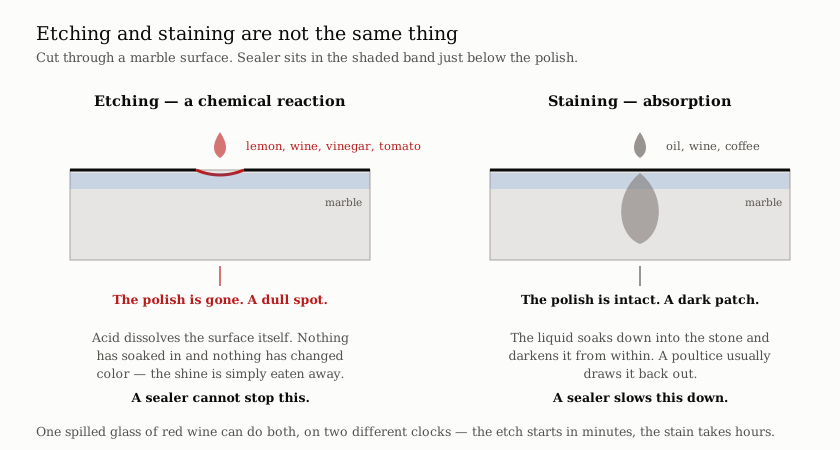
The consequence people get wrong: a sealer stops one and does nothing about the other. As the Natural Stone Institute puts it, a true sealer goes into the stone beneath the surface and prevents stains from going deep, but does nothing to protect against etching, no matter how much you apply. The two problems live at different depths.
Same glass of red wine, two clocks. Wipe it up quickly and you prevent the stain nearly every time. The acid may already have etched.
Honed marble hides etching considerably better than polished, since there's less shine to lose. It's the more practical choice for a working kitchen. Refinishing intervals run roughly two to three years for polished, and three to five for honed.
Whether that's a dealbreaker depends on what you want from a countertop. The Natural Stone Institute published a year of one writer's life with honed marble — red wine, marinara, coffee rings left twelve hours, a kombucha explosion, oil splatter — and the counters came through with no stains at all. What they did get was etching, visible only at certain lighting angles, which she describes as evidence the kitchen gets used. The only discoloration was near the sink where water pooled, and a baking soda poultice took it out.
Read that account before deciding. It separates the fear, which is staining, from the reality, which is etching.
Soapstone
Talc-based rock, chemically inert, and the outlier in this group. It doesn't stain, doesn't etch, and needs no sealing ever. It takes heat that would destroy anything else in this guide: cast iron straight off a high burner, a 500-degree sheet pan, no trivet, no thermal cracking. The reason is the same reason it's used for lab benchtops.
The tradeoff is hardness. Soapstone rates 2 to 2.5 on the Mohs scale against granite's 6 to 7, so it will scratch, and it will scratch early. It also repairs with sandpaper and a rag — 220 grit, then 400, then fresh mineral oil — which is something no other stone here can claim.
Mineral oil is the part that gets misunderstood. Unoiled soapstone is a light gray-green with white veining. Food-grade mineral oil darkens it immediately and dramatically toward charcoal. It does not seal anything — it fills the surface texture and changes how light comes off it. It's a cosmetic choice, not maintenance. Skipping it just means the stone darkens unevenly on its own over years. The Natural Stone Institute's soapstone guidance has photos of both states.
What all four share
Every slab is unique, which means the sample chip is a color reference and nothing more. Two slabs cut from the same block still differ, so a chip from a different block certainly does. Go stand in front of the actual slab. The countertops hub lists the Valley yards that let you.
Hard water is the daily fact of a Phoenix kitchen: 10 to 17.6 grains per gallon here, more in Scottsdale. The mineral film it leaves behind is best removed with acid — which is exactly what you can't use on marble and shouldn't use on any of these. Drying the counter is the real answer.
Related: Kitchen Countertops · Quartz Countertops · Laminate, Wood, Solid Surface and Porcelain · Where the Money Goes
Common questions
- Is quartzite really harder than granite?
Yes. Quartzite rates 7 on the Mohs scale and its minimum bending strength under ASTM is higher than granite's. It also doesn't etch, which marble does and some slabs sold as quartzite will.
- How do I know if a slab is real quartzite?
Three tests in the yard: press a rough edge against glass and listen for grinding, try to scratch it with a knife tip, and leave lemon juice on an inconspicuous spot for 15 minutes. Real quartzite scratches glass, resists the knife, and shows no etch.
- Do granite countertops need to be sealed?
Some do and some barely do. Granite absorption ranges from 0.02 to 0.40 percent depending on the stone, and the Natural Stone Institute says many stones don't require sealing at all. Ask about your specific slab.
- What is the difference between etching and staining?
Etching is acid dissolving the polished surface and leaving a dull spot. Staining is a liquid soaking in and darkening the stone. A sealer helps with staining and does nothing for etching.
- Is marble a bad idea in a kitchen?
It's a choice about what you want to look at in ten years. Marble will etch. Honed marble hides it far better than polished, and stains are largely preventable by wiping up spills.
- Can you put a hot pan on soapstone?
Yes, directly. Soapstone is chemically inert and handles direct heat without damage or thermal cracking, which is why it's used for laboratory benches.