Kitchen Lighting and Electrical
Kitchen Remodeling: A Complete Guide
Nobody dreams about their kitchen wiring, which is exactly how bad lighting gets planned — as an afterthought, one ceiling fixture at a time. Light is the finish you'll notice more hours a day than any other, and in a Phoenix house from the 1960s or 70s, the wires behind it deserve a look before the design gets far.
Light does three separate jobs
One ceiling fixture cannot light a kitchen well. Stand at the counter under overhead light and your own body shadows the exact twelve inches you're trying to see.
So the light gets layered. Ambient light fills the room so you can move through it. Task light lands bright and shadow-free on the work surfaces: counter, sink, cooktop. Accent light picks out what you want noticed, like glass-front cabinets or a backsplash. A decorative fixture over an island does a fourth job, which is to look like something.
The numbers on the box
Buy brightness in lumens, not watts. ENERGY STAR's replacement table makes it simple: about 800 lumens replaces an old 60-watt bulb, 1,100 replaces a 75-watt, and 1,600 replaces a 100-watt. Pick the lumens you want first, then the lowest wattage that delivers them.
How bright should the whole kitchen be? The honest answer is that no free residential standard exists to quote. What holds up in practice: task light at the counter should be noticeably brighter than the room light around it. The common recessed-light spacing shortcut (ceiling height divided by two) usually produces a reasonable layout. The fine print on both sits in The deeper detail below.
Color temperature is how warm or cool the light looks. The working convention: 2700K looks like an old incandescent bulb, 3000K is warm but cleaner, 3500K is neutral, and 4000K reads distinctly cool. Pick one and keep it consistent through the space. In a kitchen that opens into a living room, matching the two rooms matters more than which number you choose.
Color quality is where cheap lighting shows. Look for a CRI rating in the 80s; the 90s is excellent. That is the difference between tomatoes, raw meat, and skin looking right or looking gray under your new lights. The rating system's fine print is in The deeper detail.
Flicker is the one nobody thinks about until they live under it. It causes headaches and eyestrain, and bad cases make a moving mixer blade appear to slow or stop. The entire fix costs nothing at the planning stage. Choose the dimmer from the fixture manufacturer's tested compatibility list, and never pair new LED fixtures with the old incandescent-era dimmer already on the wall.
Under-cabinet lighting, and where to put it
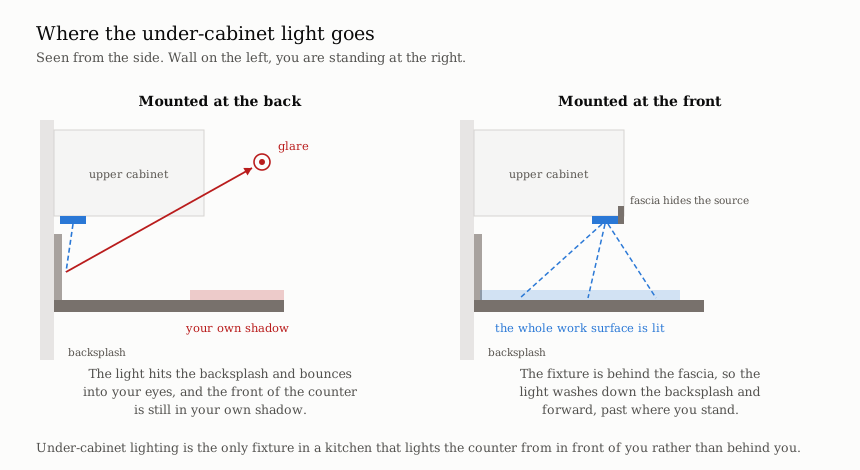
Under-cabinet lighting is the single most valuable fixture in a kitchen. It is the only light that reaches the counter from in front of you instead of behind you.
Mount it at the front of the cabinet bottom. Tucked behind the cabinet's front lip, it washes light down the backsplash and forward across the counter, out of your eyes. Mounted at the back, it aims straight at the backsplash. If that backsplash is glossy tile or a stone slab, the light bounces right back into your face, and your body still shadows the front of the counter.
Continuous LED tape or a linear bar gives an even wash of light. Puck lights make scalloped pools on the backsplash; some people want that look, most don't. Whichever you choose, the dimmer and the driver need to be a matched pair. This is the flicker problem above, arriving in the one place you're guaranteed to notice it.
One code point before you choose plug-in strips over hardwired: under the 2023 code, every receptacle in a kitchen needs ground-fault (shock) protection, not just the ones over the counter.
What the code asks for now
Phoenix moved to the 2023 National Electrical Code on August 1, 2025, under Ordinance G-7397. It skipped the 2020 edition entirely. A house permitted between 2018 and mid-2025 was built to the 2017 code, so this is a six-year jump rather than a three-year one. The city publishes its own amendments to the NEC. On the island-outlet rule specifically, a proposed amendment was submitted and denied, so that rule applies in Phoenix exactly as the 2023 code writes it.
At counter level, the code now asks for:
- Two 20-amp small-appliance circuits at minimum, serving the kitchen and adjacent eating areas and nothing else in the house.
- A receptacle within 24 inches of any point along the countertop, which in practice puts one roughly every four feet.
- Ground-fault protection on every receptacle in the kitchen, not only those serving the counter.
- Ground-fault protection extended to appliances, including hardwired ones rated 150 volts or less to ground and 60 amps or under. That reaches a hardwired cooktop or range. It's why dual-function breakers are now the default. Expect them to cost more and to trip more readily during the first weeks. That's normal behavior, not a defect.
- Island receptacles are optional rather than required, and one you do install can't go on the vertical side of the cabinet. The islands article covers the rule in full.
What a modern kitchen asks of an old panel
Get a load calculation. Don't accept a guess. A load calculation is a real procedure with real inputs: square footage, the fixed appliances, and the demand factors that apply once there are more than four of them. It produces a number for your specific house. Anyone who says a 100-amp panel "can" or "can't" handle a new kitchen without running that calculation is guessing.
The list a new kitchen adds keeps growing. Two small-appliance circuits. A dedicated refrigerator circuit, which the appliance maker often requires even where code wouldn't. A dishwasher, a disposal, a microwave, possibly a 240-volt range or induction cooktop, and dual-function breakers on most of it. Stack that on a house that also runs air conditioning through a Phoenix summer, and the calculation is the point rather than a formality.
If the service needs upsizing, plan around the utility's schedule, because the utility is usually the constraint. SRP's electric service specifications require the customer to contact SRP for an approved service and meter location before any electrical installation begins. The customer also supplies drawings and load calculations, and secures permits and clearance from the city. SRP schedules energization only after the city signs off. APS runs an equivalent process through its own service requirements manual. A panel upgrade is a contractor, a city, and a utility all on one schedule.
What turns up in older Valley houses
Single-strand aluminum wiring, roughly 1965 into the mid-1970s. If your house has it, plan the repair into the remodel. Kitchens are where it shows up worst. That's where the high-current circuits and the most connections are, and a remodel means every device gets handled. The Consumer Product Safety Commission found that homes built before 1972 and wired with aluminum are 55 times more likely to have connections reach fire hazard conditions. The heat builds at the connection points whenever current flows. Two repairs work, per CPSC. The first is the COPALUM crimp, which cold-welds a copper pigtail onto the aluminum wire with special tooling. The second is the AlumiConn miniature lug connector, named in CPSC's repair guidance for the common case where a COPALUM-certified installer can't be found. What does not work, in CPSC's own testing, is ordinary twist-on wire nuts; substantial numbers of them overheated severely. CO/ALR-rated switches and outlets perform better than standard ones, but CPSC calls them an incomplete repair.
Federal Pacific Stab-Lok and Zinsco panels. These deserve care rather than alarm. InterNACHI recommends evaluation by a qualified electrician on sight for both brands. The practical argument usually settles the question anyway. Replacement breakers for these panels are still made but expensive and hard to source, so a kitchen that needs three new circuits usually needs a new panel regardless of the safety debate. The murkier federal record is in The deeper detail below.
Ungrounded two-prong circuits are the third common find. They're a design question rather than an emergency, once your electrician has looked at them.
The deeper detail
The sourcing behind the short versions above, for readers who want it:
- Brightness standards. The Illuminating Engineering Society's residential recommendations live in a paid standard. The free IES figure that circulates online — 50 to 100 footcandles — is for food-prep surfaces in a commercial kitchen. It's a fair upper reference point, not a residential recommendation, and anyone presenting it as one is guessing. The spacing shortcut (ceiling height divided by two) traces to no standards body at all; it's a trade rule of thumb that generally produces a reasonable result.
- Color temperature labels. The Department of Energy defines the metric but doesn't characterize individual values, so the familiar descriptions of 2700K through 4000K are trade convention rather than published guidance.
- Color rendering ratings. DOE's own thresholds put CRI in the 70s at acceptable for interiors, the 80s at good, and the 90s at excellent. R9 measures deep reds specifically, and DOE's bar is more modest than the marketing: an R9 above zero is generally considered acceptable, not the 50-plus you'll see advertised. DOE also notes CRI's real limits, including that a low-CRI source can sometimes render objects more pleasingly than a higher-CRI one, and points to TM-30 as the better modern measure.
- Flicker engineering. DOE names phase-cut dimmers — the triac type built for incandescent bulbs — as particularly problematic when paired with cheap LED drivers that lack smoothing capacitance. The IEEE recommended practice caps modulation at about 10 percent at 120 Hz, easing as frequency rises. Documented effects run from headaches and eyestrain to the stroboscopic effect, where moving objects appear to slow or stop.
- The Federal Pacific record. CPSC found in 1983 that Federal Pacific breakers failed certain UL calibration tests, but closed its investigation stating it was unable to link those failures to a hazardous situation. The home inspection industry takes the firmer line noted above.
Permits
Phoenix requires a permit for electrical updates and rewires, and the residential remodel process runs through plan submittal, review, and inspection. Minor work can sometimes clear over the counter without the full review queue. The where the money goes article covers what a permit costs and where it sits in the schedule.
Related: Kitchen Remodeling Guide · Kitchen Appliances · Kitchen Islands · Where the Money Goes
Common questions
- How bright should kitchen lighting be?
There's no free residential standard to quote — the Illuminating Engineering Society's residential guidance is a paid document. The published IES figure of 50 to 100 footcandles is for commercial food-prep surfaces and makes a reasonable upper reference. Task lighting at the counter should be considerably brighter than the ambient light in the room.
- Where should under-cabinet lights be mounted?
Toward the front of the cabinet bottom. Mounted at the back, they light a glossy backsplash that reflects into your eyes, and your body still shadows the counter.
- Why do my LED lights flicker on a dimmer?
Almost always a mismatch. Older phase-cut dimmers built for incandescent bulbs chop the waveform, and an inexpensive LED driver can't smooth it out. Use a dimmer from the fixture manufacturer's compatibility list.
- Does a kitchen remodel require a permit for electrical work in Phoenix?
Yes. The city lists electrical updates and rewires among permitted work, though minor jobs may qualify for an over-the-counter permit.
- Do I need to upgrade my electrical panel?
That comes out of a load calculation for your specific house, not a rule. If the answer is yes, the utility has to approve the service location before work starts and won't energize until the city signs off.
- Is aluminum wiring dangerous?
CPSC found homes built before 1972 with aluminum wiring are 55 times more likely to have a connection reach fire-hazard temperature. Twist-on wire nuts are not a fix; CPSC recommends a COPALUM crimped copper pigtail.